To a certain extent, working at a university can inoculate one to strange communications. Students, from the eager freshmen to jaded seniors, tend to have their idiosyncrasies, especially when sending missives at 11:59 PM. My experience shows the public in much the same light. Perhaps this is the consequence of my specialty, researching mammalian sperm, and my location, Sarasota Florida. The occasional elderly retiree will inquire about how he might have a second batch of children with his fresh, nubile wife and I will gently redirect him to a reproductive clinic as my lab is seldom in need of human test subjects. This letter however was in a class all its own. An effort had certainly been made. It was hand written for God’s sake! I haven’t gotten a hand written letter beyond season’s greetings in 10 years.
There was no doubt in my mind it was a prank by one of my students, likely an undergraduate in reproductive biology. Every so often, in the quite commotion before class, I like to turn up my hearing aids and listen into the unfiltered reaction to my pedagogy. The consensus I had gleaned that semester pegged me as something of a cook, grown senile on my tenure, and a fine candidate for poking fun at. What they didn’t realize of course is that I remember what it was like to have a sense of humor too. I suppose that was at least thirty years ago, right about the time our so called “Anthony” grew his flagellum.
What a ridiculous story. Spermatozoa of course have no capacity for autobiographical memory as the letter describes. Such advanced recollection is only possible thanks to the interactions between billions of neurons in the brain. Anything which might be called memory on the single cellular level is far more primitive. If this story were genuine, it would be nothing more than imagination mistaken for memory. The real kicker, what makes me so confident of its dubious providence, is the name, Anthony Hook. For the uninitiated, it’s an unsubtle reference to Antonie Van Leeuwenhoek, the famous microscopist and discoverer of sperm. Leeuwenhoek is somewhat infamous for his view that embryos were contained, preformed, within the spermatic worms, as they were called at the time. Anthony would have made Antonie proud. Sad then that the hypothesis has been discredited for well over two centuries. Even so I like to mention it in reproductive biology as an amusing historical curiosity.
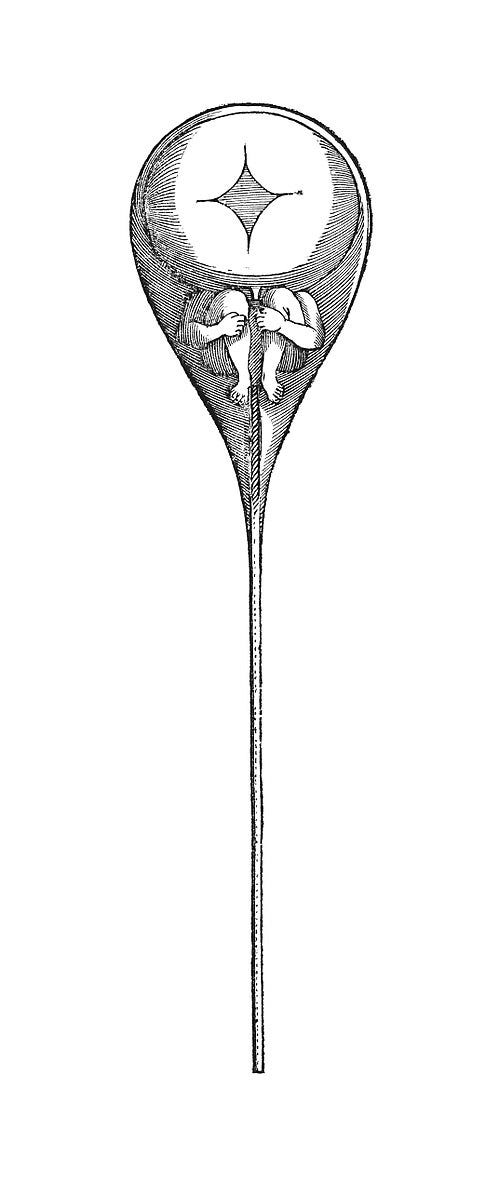
Apparently, a student had found it mightily amusing indeed. They’d also been paying at least some attention to the basics of spermatogenesis too. It is true that spermatozoa develop with groups of a few dozen, all descended from the same stem cell, connected to each other via bridges in their cell membranes. It’s a good setup for cells with only a single set of chromosomes since, if they are lacking an important gene, their connected neighbors can send them those missing genes’ products.
Ridiculous as it may have been, the prank niggled at the back of my brainstem for the next few days. I itched at this niggle by glancing at handwritten notes in class and turning up my hearing aids, hoping to catch a clue as to who might be behind Anthony’s pen. No luck. As the week’s ultimate slide came and went, I dismissed the class to their hedonistic weekend, closed my laptop and packed up my notes. Down two flights of stairs I went, back to the dingy office which I call home during the work day.
Creech Hall was no architectural marvel. Cinderblock walls, sparse windows, buzzing florescent lights, all contribute to the impression it had been designed with only the vaguest idea it would be subject to human habitation. Despite the indignity of these conditions, conducting some three decades of detailed research within these walls has given me a certain tolerance, if not fondness for them. My office, a windowless, beige cube, located across the hall from my lab, was similarly tolerable (though I have replaced the florescent lighting with warm LEDs). On the first Saturday of every month, I take the morning to organize this depressing little haven into a semblance of order.
This happened to be the Friday just before my monthly cleaning. The poor room looked as though a slow motion whirlwind had snuck its way in through the vents and methodically covered every available surface above floor level with papers and books. First Saturday be damned, I thought while looking over the mayhem. Reference books back on the shelves, spam mail into the recycling bin, pens back into drawers, and then I came across that preposterous letter, buried below a book on acrosomal enzymes.
I was an inch away from tossing it out alongside flyers for the city council campaign of Percy “the Punisher” Pilchard (who promised to make the Sarasota streets safe again by sending everyone between ages 16 and 35 to death row, those being the demographics who commit the overwhelming majority of crime. Burdensome as my teaching responsibilities can be, I do still think this solution may be a bit too drastic.) but instead I paused to take a closer look. The envelope had a return address in Kalamazoo, Michigan, and was even postmarked in Grand Rapids. The pranksters had put in some leg work to conceal their provenance. Good grief, Maybe they were even expecting a response. At this thought a wicked grin crept across my face. Why, I’d been approaching this all wrong. I shouldn’t be spying for circumstantial evidence in class, but instead playing along till the hoaxsters revealed themselves by some slip of the tongue. Perhaps, I considered, this could go wrong. Perhaps the pranksters would hold some credulous communication I’d sent and threaten to publish it if I didn’t bump up their mid-term grades. But, just as there is a certain freedom at the beginning of a career, there is freedom too when nearing the emeritus stage. I’ve accomplished most of what I’ll likely do, my productivity and responsibility are on the wane. And what else is tenure for if not to enjoy leeway in one’s intellectual pursuits?

At this thought the wicked grin reasserted itself. I grabbed my old stationary kit, sneezed at the cloud of dust it gave off, and set to work composing a response. Time to become the senile old cook they expect of me.
Dear Mr. Hook,
Thank you most heartily for your correspondence, I can’t say I’ve received anything of its sort before this most auspicious of occasions. The depths of your memory are nothing short of profound! I can certainly understand why you may be having a modicum of trouble convincing medical doctors of your veracity as such memories are quite unprecedented in the literature. However, I can indeed confirm several details of your story, sperm cells do grow in attached clusters, beginning as fat, blobby things which then eject much of their cytoplasm to become trim and thin. This is not to mention the matter of half being able to produce male offspring and the other female. Your talk of brothers and sisters is surely made sense of in that light.
Though your account was nothing short of engrossing, I can’t help but wish for more details. You have expressed reticence about being the subject of a study and I can assure you that I will be happy to oblige these wishes, but would you be willing to indulge an old academic’s personal curiosity? Much can be done in print but I believe a telephone conversation would be more enlightening. My number is 941-420-6969 and you may call me after 4:30 PM, EST, on a day of your convenience.
Regards,
Philip Gulliver
I folded the letter, addressed the envelope, licked it shut, and tossed it into the outgoing mailbox. Many years ago, in those halcyon times before I was buried under the workload a professor enjoys, I had played a game of correspondence chess. I lost in humiliating fashion and swore off the game ever since but for those first few exciting moves it felt quite like sending out this letter. The game was a totipotent stem cell, the possibilities of its lineage unlimited. But then my opponent and I began making our fate decisions and the game developed into this: Mate in 10. But for now the prank was still pluripotent and all I could do now was await a response.